OUR METHOD · AGILE APPROACH
A clear direction.
Progress
you can see.
Understand your business, build in iterations and decide on the next steps together. Here is how we organise the work.
Explore the agile cycleVisible progress.
01 / BEFORE BUILDING
Understand the need.
Define the first useful version.
We start with your day-to-day work and constraints to define a feasible project.
Use cases
Who uses the tool, and for what?
View details +
- Users and their journeys
- The problems to solve
- Business situations and rules
The scope
What we build first.
View details +
- Priority features
- Required integrations and access
- Budget, security and scheduling constraints
Approval
How to recognise a useful result.
View details +
- Acceptance criteria
- The people who make decisions
- Demonstration and acceptance testing arrangements
Shared scope, priorities and acceptance criteria.
02 / AN ITERATIVE APPROACH
Build. Demonstrate.
Learn. Adjust.
The product progresses through successive versions. Feedback guides what comes next, at a pace agreed with you during scoping.
Choose the next useful step.
We turn the need into concrete tasks and choose together what adds the most value now.
- The team’s work
- Break down features, identify dependencies and estimate the work.
- Your involvement
- Share business priorities and decide on the iteration’s scope.
- The outcome of this stage
- A prioritised work list and shared objective.
Shape the product.
User journeys and features take shape. Technical choices support the use cases we define together.
- The team’s work
- Design, develop, integrate and test functionality as it is built.
- Your involvement
- Clarify business rules and answer the questions that inform decisions.
- The outcome of this stage
- A product increment, ready to test and demonstrate.
Test the result against real use cases.
We check functionality and the agreed criteria. Issues and work requiring revision become visible.
- The team’s work
- Run planned tests, analyse gaps and prepare fixes.
- Your involvement
- Test journeys against your use cases and share any gaps.
- The outcome of this stage
- Test results and a list of fixes or approvals.
See, discuss and adjust.
A demonstration enables discussion of the actual product. Your feedback informs priorities for the next iteration.
- The team’s work
- Show progress, explain decisions and gather feedback.
- Your involvement
- Give feedback on usage, validate agreed deliverables and clarify what comes next.
- The outcome of this stage
- Shared feedback, decisions and updated priorities.
↺ Feedback and fixes become priorities for the next iteration.
03 / RESPONSIBILITIES
A shared project.
Clearly assigned roles.
Who decides, who delivers, who supports: the framework is agreed before starting.
Context and priorities.
You bring business knowledge and the people who approve the work.
In practice
- Share use cases and constraints
- Make decisions on priorities and changes
- Check and approve the agreed items
The product and its quality.
Consultants carry out the work and make progress visible.
In practice
- Propose and explain technical choices
- Develop, test and demonstrate features
- Flag dependencies and difficulties
The framework and the connection.
Points of contact and responsibilities are identified at the start.
In practice
- Supporting consultants throughout their assignments
- Facilitate communication with your team
- Follow up on adjustments and prepare next steps
04 / VISIBILITY
You see the work.
And you can discuss it.
Project-specific tools that make priorities, progress and decisions accessible.
A shared backlog
Features are described and prioritised. You know what is planned, what is in progress and what still needs a decision.
Journeys to discuss
Wireframes or a prototype make decisions visible before development. We check screens and actions with the people involved.
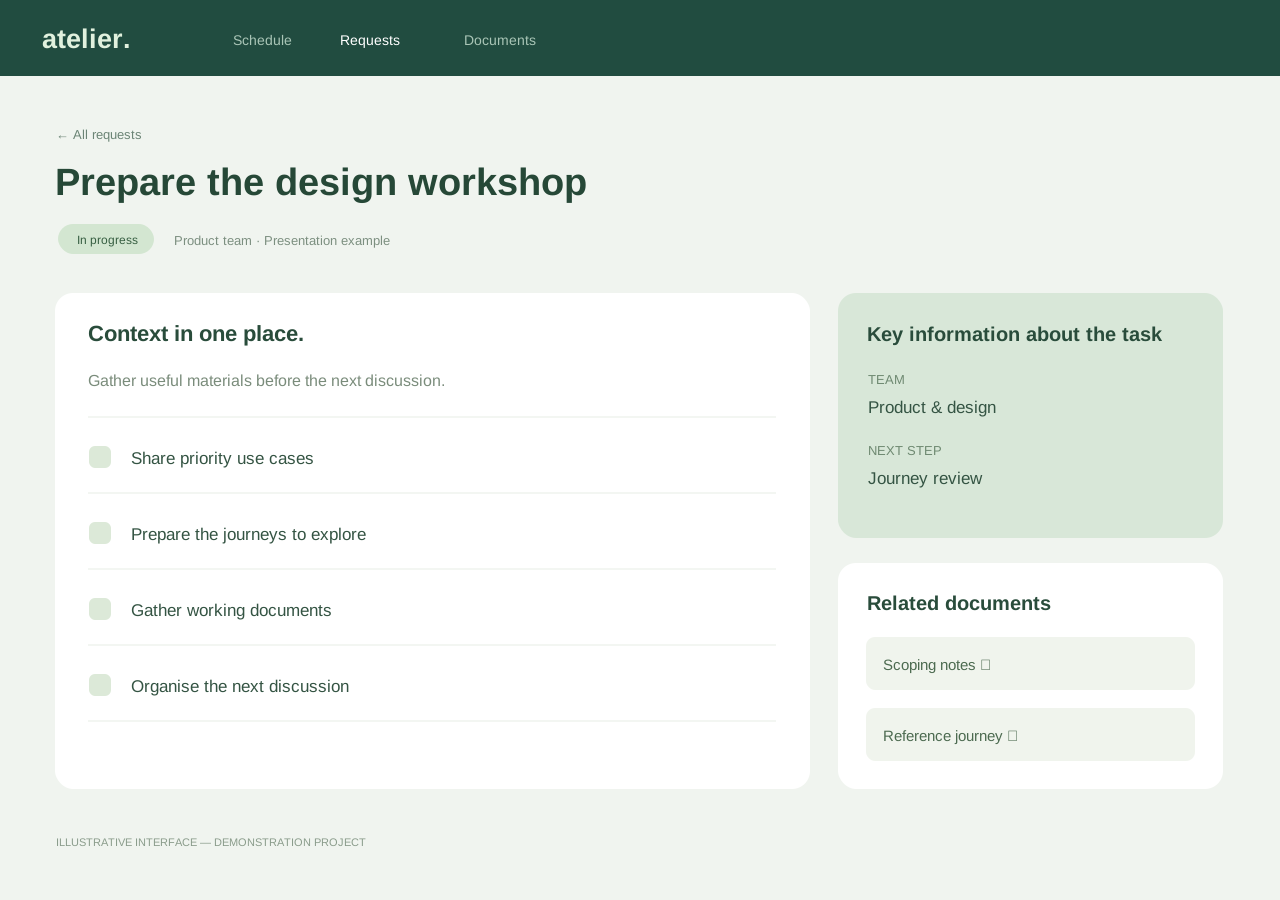
Practical demonstrations
You see the completed features. The demonstration starts a discussion about how they work and what needs adjusting.
Decisions you can find
Approvals, open points and important decisions remain accessible. Everyone knows what the next step concerns.
05 / QUALITY & HANDOVER
Deliver a tool.
Prepare it for use.
We prepare launch with your teams. Deliverables and handover arrangements are specified within the agreed scope.
- 01
Verify
Functional and technical tests suited to the scope; gaps identified and fixes tracked.
- 02
Validate
Acceptance testing against agreed use cases with the people responsible for approval.
- 03
Launch
Preparing environments, access and deployment stages.
- 04
Hand over
Useful documentation, handover materials and agreed maintenance or development arrangements.
- Code & configuration
- Useful documentation
- Acceptance test results
- Access & handover
The materials handed over and associated rights are defined in the proposal and contract.
06 / YOUR ENGAGEMENT MODEL
A clear framework.
Built around your organisation.
We reinforce
your team.
Your operational priorities, tools and routines form the framework for the assignment. We organise consultant onboarding and support with you.
- Defined role and objectives
- Consultants integrated into the way you work
- B&M project lead throughout the assignment
We deliver
your solution.
We define the scope and initial version together. Iterations, demonstrations and approvals structure product delivery.
- Agreed priorities and initial version
- Progress demonstrated and feedback incorporated
- Launch and handover arrangements
IN PRACTICE
Questions
before getting started.
What is an iteration?
A period of work focused on a specific objective. The team builds and verifies a product increment, then demonstrates it. Feedback helps adjust the next priorities.
How frequently do iterations take place?
The pace depends on the product, constraints and stakeholder availability. Iteration length, demonstrations and decision points are agreed during scoping.
Can the scope evolve?
Yes: feedback can change priorities. We review the impact on effort, schedule and budget with you before agreeing changes.
Who is our contact at B&M?
Points of contact and responsibilities are identified before work starts. For team reinforcement, a project lead supports consultants and monitors collaboration. For a project, management and approval arrangements are defined in the chosen engagement model.
What happens after launch?
Handover, maintenance and future development are organised around your teams and agreed arrangements. We address these before delivery to prepare access, documentation and responsibilities.
Do we need a specification document before starting?
Your context and initial priorities are enough to start the conversation. Scoping then clarifies use cases, constraints, scope and acceptance criteria.